
Why is REC advocating for old style cordless phones?
The "Direct Final Rule" process needs to be used for "cleaning" the CFR of rules regarding obsolete technologies, not take away the frequency and/or power privileges of devices that are not obsolete.

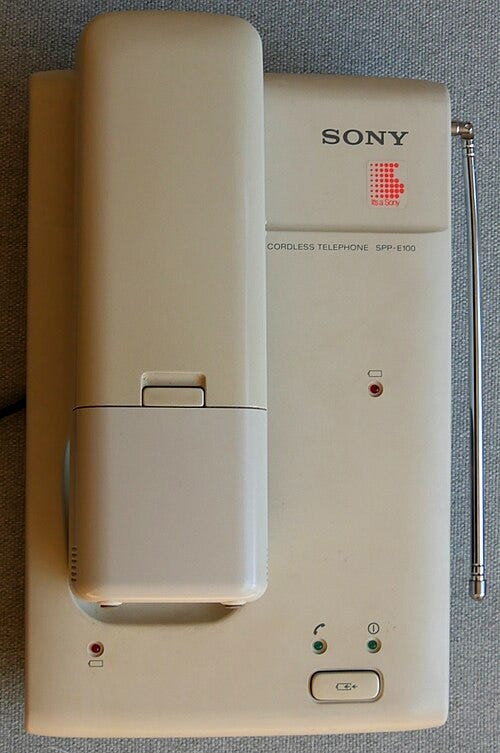
Under Commissioner Brendan Carr, there has been a substantial effort by the FCC called In re: Delete Delete Delete to identify and eliminate or amend regulations in Title 47 of the Code of Federal Regulations (CFR) also known as the “FCC Rules”. A part of the overall initiative is to “delete” rule sections or subsections that may be either non-applicable or duplicative outside of the CFR. This was in response to the overall efforts of the now-former Department of Government Efficiency (DOGE) to reduce the CFR. In these cases, the Commission is identifying regulations also associated with obsolete technologies, such as regulations related to NTSC analog television receivers and telegraph service. These deletions can be done through a Direct Final Rule (DFR) process where there is no formal rulemaking process where comments and reply comments are invited. Instead, there will be a period where, within 20 days of the Order’s publication in the Federal Register, interested parties can file concerns regarding the proposed deletion of a rule. We have found that in most cases, the items being proposed for removal in the CFR were definitely justified and REC had not raised any issues.. until now.
The rule in question is §15.233. Part 15 of the FCC Rules relates to “radio frequency devices”, both “intentional radiators” which actually are intended to transmit a radio signal and “unintentional radiators” that because of the nature of the equipment, they emit a signal in the electromagnetic spectrum such as computers and power supplies. §15.233 is a rule that is specific to devices operating within the bands 43.71~44.49, 46.60~46.98, 48.75~49.51 and 49.66~50.00 MHz. This rule section states that:
(a) §15.233 is limited to cordless telephones.
(b) Telephones must operate on paired channels (a table of frequencies is included in the rule section), include a mechanism to prevent the phone from transmitting on a channel pair already in use and the instruction manual must indicate that placing a cordless phone near a TV or VCR may cause interference.
(c) The field strength of the fundamental emission shall not exceed 10,000 microvolts per meter (mV/m) at 3 meters.
(d) The fundamental emission is limited to a bandwidth of 20 kHz.
(e) Any emission that exceeds 20 mV/m must be reported in the application for certification.
(f) If the device provides for the connection of external accessories, the device must be tested with the accessories attached.
(g) The frequency tolerance of the carrier signal shall be maintained within +/- 0.01% of the operating frequency.
(h) If the device does not comply with a different cordless telephone rule, §15.214(d) regarding digital security codes to obtain access to dial tone, the packaging must include a warning message stating that the phone may pick up other radio frequency devices or RF noise resulting in the phone line being used with the knowledge of the intended user.
The cordless telephones at issue here are the second generation of cordless telephones where both the base and handset frequencies are within the 43.71~50.00 MHz bands shown above. Some of these models were marketed as “46/49” cordless phones. The first generation phones had a handset frequency in the 49 MHz band a base frequency in the 1.7 MHz band, above the AM broadcast band. Later generation phones use digital encryption for privacy and utilize frequencies in the 900 MHz, 1200 MHz and other bands in the UHF spectrum.
In the circulation draft to be considered as an agenda item for the FCC’s December Open Meeting, is a DFR for the Agency’s Office of Engineering and Technology (OET). This DFR proposes to completely delete or otherwise amend several regulations in Parts 15 and 18 which are in the purview of OET. One of the rule sections planned for complete deletion would be §15.233.1 By deleting this rule, it would eliminate the ability for these devices to be used as it would eliminate the allowance that these devices can operate with a power level of 10,000 mV/m at 3 meters. Without this specific allowance, low power devices operating in this spectrum would be limited to 100 mV/m at 3 meters. In the circulation draft footnote, OET claims that these phones “no longer operate in these bands”. They provide no evidence that every single 46/49 cordless telephone has been committed to the landfill.
When REC posted the other day on Facebook about this change, we received comments that these phones are obsolete, lack privacy and question our inquiry into why we are going out of our way to protect these devices.
Many know REC for our work with broadcast regulations but may not understand REC’s full 41-year history or our overall objectives. In our objectives statement, as part of “Citizen’s Access to Spectrum”, we state that REC does “involve itself” in “non-broadcast service issues such as the Amateur Radio Service, Personal Radio Services (CB, GMRS, MURS, FRS), broadband access and other subjects in the FCC’s jurisdiction.” REC got its start by using the public switched telephone network to deliver content and we have always been “phone phreaks”. Therefore, spectrum that is allocated for telephones would definitely fall within our operational objectives.
As far as the obsolescence of these devices, REC disagrees with OET’s general findings that these phones “no longer operate”. The OET provides no proof of that. We stated it is very possible that there are still some rural or elderly users of these devices because they simply have not changed them out (if it ain’t broke, don’t fix it). In addition, there are also telephone collectors that may still possess and use these devices. We also stated that unlike other issues that have been considered in this and past Delete Delete Delete proceedings, this proposed rule deletion removes operating privileges for a device that continues to be completely compatible with existing technology. Existing technology is any device that provides talk battery, ring generation and permits a two-way full duplex telephone conversation to take place. These devices directly plug into devices such as terminal adapters associated with Voice over IP (VOiP) services, key system and PBX devices (such as those used by collectors and some legacy businesses) as well as those that are directly connected to wireline PSTN either through copper, pair gain or fiber connections through a modular jack on the wall or an interface device. In other words, a 46/49 style cordless phone with a good handset battery can still be used to place and receive telephone calls.
While there may not be many of these devices still in circulation, the deletion of §15.233 would eliminate the 10,000 mV/m at 3 meter field strength allowance in favor of the default 100 mV/m and would make the use of these devices “unauthorized operation” in violation of §301 of the Communications Act. To put it simply, it will make the use of these devices similar to radio piracy.
REC’s position that any rule proposed for deletion of any rule under DFR that arbitrarily deletes operating privileges outside of a full rulemaking process does not fall into the “public interest” exemption in the Administrative Procedure Act (see 5 USC §5.53 (b)(4)(B)) and that the DFR cannot be used for those purposes. If the Agency allows §15.233 to be deleted by DFR, this could set a precedent that would give the FCC free reign to eliminate frequency operating privileges or make other substantive rule changes without having to go through the normal comment and reply comment process.
In other words, the FCC wants to ban a certain consumer device, which can still be used, is not being done to free up spectrum for another service and is being done under such a general assumption that these devices are “no longer used” without any documentation to back up that claim. This is not what the Delete Delete Delete DFR process was intended for. There is no reason other than “this rule is taking up space in the CFR” to delete this rule.
The concept of issuing circulation drafts three weeks prior to the FCC Open Meeting was an initiative started by former Chairman Ajit Pai and was intended to provide more transparency at the agency. Under the current Sunshine Act policies as described in §1.1203 of the FCC Rules, no person may contact FCC decision making personnel in less than one week before the scheduled Open Meeting (when the Sunshine public notice is released) regarding an item on the published agenda.
REC wrote a letter to the attention of the head of OET, the Chairman and the other two Commissioners to voice our concerns regarding deleting §15.233 through DFR alleging that it is not appropriate for this rule to be included as it would constitute a substantive change in regulations (a loss of an increased field strength/power for a consumer device that may still be used). This letter was sent on November 29, 2025, more than seven days in advance of the December 18, 2025 Open Meeting. We are requesting that this specific item be removed and recirculated to the Commissioners in respect to the DFR that will be voted on December 18.
While on its face, it may seem like REC is doing this to protect telephone collectors and rural users of this equipment, which is true, but it also exposes the carelessness that the Agency is conducting as a part of their mass eradication of regulations. In other words, banning an existing device that has been in circulation for several decades, utilizing technology that is still available does not meet the same level as the deletion of rules regarding kits for cable television interface devices that were used in the NTSC analog television days.
By allowing §15.233 to be deleted by DFR, the Agency is expanding Delete Delete Delete into new territory causing a dangerous precedence for future Delete proceedings. All FCC regulated services and devices should be worried about such a precedent.
See footnote 5 on page 3, see also proposed rule text on page 8.