
REC Preliminary Statement: Proposal for new 250 (or 500)-mile AM on FM Translator Filing Window
REC does not outright oppose a 250 or 500 mile move, however there must be safeguards put in place to protect LPFM stations and to prevent speculation.


A Petition for Rulemaking has been filed by Press Communications, LLC, licensee of WHTG(AM), Eatontown, NJ and co-signed by several other broadcasters to propose that the FCC open another opportunity for the licensees of AM stations to be able to acquire existing FM translators and allow them to be moved up to 500 miles for the purpose of allowing the translator to be used as fill-in service for an AM station. This is similar to the 2016 “250-mile move” opportunity that was provided in former FCC Chairman Ajit Pai’s “AM Revitalization” initiative, MB Docket 13-249 (paras. 12~17).
Unlike the previous 250-mile move window of 2016, Press, et. al. is requesting that the maximum move distance be 500 miles instead of 250. They cite that the additional distance is needed because stations on both coasts, the Gulf of Mexico and in the border areas were at a disadvantage because they did not have a full 250-mile circumference in all directions to translators from. They also want the move opportunity to make this 250/500-mile move opportunity permanent. They also want to impose a limitation of a maximum of “3 translators per AM station license”. The latter is so no AM station is forced out of the market by additional FM translators by either a huge entity acquiring dozens or a greater number of translators for a particular station or a greater number of FM translators for a particular AM station or a competing station upsurping all available FM translator spectrum in a market. In the previous 250-mile move window, AM stations were limited to only moving one FM translator. They also want to give Class C and D AM stations a head start, which is consistent with the 2016 opportunity.
Today, FM translators can only be moved a distance where the 60 dBu contour of the current facility overlaps in part with the 60 dBu contour of the proposed facility. A separate process, called a Mattoon Waiver can be used to move an FM translator a farther distance if the translator is to be used for AM fill-in service, does not impact future LPFM availability in “spectrum limited” markets, there is mutual exclusivity in either direction between the current and proposed translator facility, and the applicant does not have a history of multiple filings in order to slowly move a translator to the desired location through a series of minor modifications.
In the past, other LPFM advocates had opposed the 250-mile move opportunity because it would not pass the statutory muster of Section 5 of the Local Community Radio Act of 2010. At that time, REC did not take this position because Section 5 of the LCRA applies only to new FM translator, LPFM and FM booster stations and not to the move of existing stations. The LCRA would only come into play if new (drop-in) translators were being proposed, similar to the Auctions 99 and 100 filing windows in 2017 and 2018. At that time, REC’s position was that because AM stations were limited to one FM translator and each translator obtained through the Auction window would be permanently “married” to the AM station with no opportunity to change the translator’s primary station, the addition of the translators would fall under “community need” as required in §5(2) of the LCRA. We note that the Press petition does not propose the opening of a new auction filing window for new FM translator stations, only the modification of existing FM translator stations.
Because REC’s constituency is more than just LPFM stations (which we are commonly stereotyped as), but also includes smaller commercial and noncommercial AM and FM broadcasters, especially those in rural areas, we must look it in a way that protects the interests of LPFM stations as well as those of smaller AM broadcast stations.
Over the years, REC has either witnessed or received complaints regarding FM translators proposing strangely designed composite directional antennas that are engineered as a way to completely surround an LPFM station, such as the recently filed modification by W276DV and its impacts to WUGR-LP near Hollywood, FL, which has resulted in an Informal Objection (incorrectly presented as a Petition to Deny) opposing the modification of the translator.
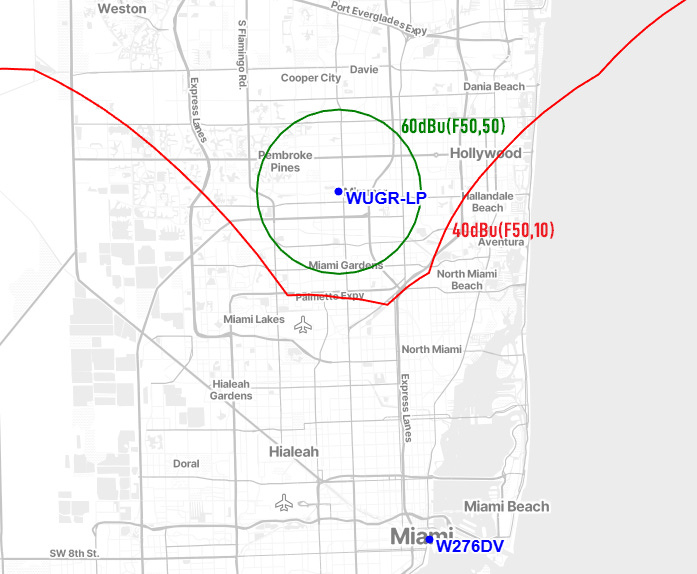
REC has always been concerned about these types of arrangements, especially where such antennas would be very costly and where some translators authorized in this manner would eventually build with a different antenna which may cause actual interference. While LPFM stations do have recourse under §§ 74.1203 and 74.1204(f) of the rules, those rules are based on the contour and not on actual operations. LPFM stations may not have recourse to address an improper antenna because it would require FCC field enforcement to inspect the translator antenna and as many of us know, broadcasting is well on the bottom of the FCC’s field enforcement triage as it does not involve high value commercial services nor safety of life communications.
While it may be necessary for REC to first conduct a constituent survey before going on the record with the FCC on this proposal (which we may do if this petition receives an “RM” number and it opens for comments), we will make our initial positions on this issue in a manner that would be a compromise across our entire constituency. These positions are subject to change based on the outcome of a constituent survey.
250 vs. 500 mile move: If the Commission was to entertain a 500 mile move distance, REC would insist that a move between 251 and 500 miles would only be allowed for AM stations in the continental United States and Alaska that are physically located less than 250 miles from one or more of the following: Pacific Ocean, Atlantic Ocean, Gulf of America (as recognized under Executive Order 14172, also recognized as some as Gulf of Mexico)1, the common border with Canada and the common border of Mexico.
Three station maximum: We do not agree with the three station maximum. Instead, we would call for that the number of stations be limited to two and whether the Commission was to go with two or three stations, any translators that were granted (even if not built) in the original 250-mile move or obtained new in Auctions 99 or 100 would count towards those two stations. This means that many AM stations would be able to move one translator and those who did not participate in 2016~2018 would be able to move two.
Licensee of moved station: REC would insist that the licensee of the translator be the same as the licensee of the AM station which will be designated as the primary station. If the current licensee of the FM translator is different, then an application to request consent to assign the FM translator authorization must be filed simultaneously. In cases where an assignment application is filed, program testing and/or licensing would not be authorized until the assignment is both granted and consummated. This prevents speculation. Once moved in this manner, the translator cannot be assigned again for the lifetime of the translator and must be simultaneously assigned or cancelled if the AM ownership changes.
Primary station designation: The primary station of the FM translator must remain the AM station and cannot be changed in the future at any time. In the 2016 opportunity, the FM translator only needed to operate with that AM station as the primary for four years of licensed operation. This would be a permanent marriage similar to those translators authorized in Auctions 99 and 100. This will prevent a translator being moved to a more prominent metro area and then after four years, being sold off to be used for a different station. REC could consider situations where the primary station is redesignated to a different AM station that is commonly owned by the licensee in the same area.
Translators within close proximity to an LPFM station: Any translator that proposes to operate within 67 km of one or more LPFM stations on co-channel and/or within 35 km of one or more LPFM stations on first-adjacent channels and with a directional antenna must be subject to §74.1235(i) which requires that a directional antenna must have a proof of performance (including computer modeling for antenna models that were previously physically proofed) with the exception of “off the shelf” directional antennas used in a single antenna (non-composite) configuration and in all cases (including “off the shelf”), must certify that the antenna is mounted per the manufacturer’s instructions and to certify that the antenna is mounted in the proper orientation and location. The latter would have to be conducted by a licensed surveyor (this is a rule that we would like to see with all future FM translator modifications and construction permits, regardless of primary station).
New FM translator stations: Even though this proposal does not call for the creation of new FM translator stations (only the moves of existing ones), we absolutely oppose a second set of auction windows for new “FM into AM” translator station construction permits. Actually, we oppose any new translator filing window (either in the non-reserved or reserved band) until the FCC puts the safeguards in place as proposed by REC in RM-11952 in order to comply with the LCRA and to address the changed role of fill-in FM translators.
We see these counter-proposed compromises to be a happy medium that does address the issues being faced by current smaller AM broadcast stations and to protect the current base of the 2,000+ LPFM stations currently operating or otherwise authorized.
Again, these are not our final positions, just our starting points. We do welcome feedback on these positions and any compelling arguments that could sway our position knowing that any such arguments must be consistent with both the interests of LPFM stations and those of AM broadcasters seeking FM translators.
Edited to correct the RM number of REC’s Translator Reform petition for rulemaking.
Edited to change text and add footnote 1 regarding the gulf coast of the southeastern United States.
When this article was originally published, we had identified the major body of water that borders Texas, Louisiana, Mississippi, Alabama and western Florida as “Gulf of Mexico”. Concerns were raised by some constituents stating that REC is biased to the left. REC has and always will maintain political neutrality through our “bonnet on” policy. REC is aware of the 2025 Executive Order 14172 that renamed that body of water as “Gulf of America” as recognized by the United States Government. However, that designation is under contention from one side of the aisle. We note that the International Hydrographic Organization also recognized the “Gulf of Mexico” name as well as many nations. However, there are some on the one side outside the bonnet who still recognize that name, mainly in political protest. Based on the constructive feedback received from constituents on the right, we can understand how identification in this manner could put REC’s neutrality into question. We do note that in a legal “on the record” filing with the FCC, we would be inclined to use “Gulf of America” because if you speak to the Government, you have to speak their language, including recognition of a name that may be under political contention. Such a communication we feel would not violate the bonnet when done in a legal context. To address our constituents concerns, we changed the wording to “Gulf of America (as recognized under Executive Order 14172, also recognized as some as Gulf of Mexico)”. We feel that this is within the bonnet because it addresses two facts: (1) Executive Order 14172 and (2) that some have decided to recognize it as “Gulf of Mexico”. We never intended the use of either place name to raise such a major concern. This puts REC in a difficult situation and we could understand how our previous recognition may have violated the bonnet and that was not our intention. We hope the resolution presented here will be satisfactory to both sides.