
Understanding the limitations on FM translators for LPFM stations
LPFM being a hyperlocal service is intended to serve only a small area. The rules regarding commonly-owned FM translators are consistent with those intentions.

There has been a lot of excitement regarding the upcoming filing window for new noncommercial FM translators in the (88.1~91.9) reserved band. This includes excitement from LPFM stations as this will be the first real opportunity for new stations since LPFM stations were allowed to own translators back in 2013.
However, based on some of the requests for FM translators from LPFM stations, we do need to reiterate the actual rules and the mindset of the FCC back in 2013 when they created these rules. We have seen cases where LPFM stations are wishing to place a station about 10 to 15 miles away, especially in more rural areas where communities are further spaced from each other or they are expecting a nice fat signal that will cover a lot of additional communities. Some may see where “fill-in” FM translators are covering and think that they could get similar results.
When the ability for LPFM stations to own translators were being discussed in the proceeding that resulted in the Sixth Report and Order in 2013, you had two sides of this issue. NAB and NPR opposed cross-ownership because of the potential impact to the “local character” of the LPFM service.1 REC countered stating that cross-ownership would enable LPFM stations to better reach their local communities; National Lawyer’s Guild and Media Alliance stated that translators could help overcome some terrain issues and several stated that FM translators could allow stations to serve their entire intended service area, such as a single county.2
To understand this concern about local character, we need to go back to the original 2000 Report and Order where the intention of LPFM was to provide service to “very localized communities and underrepresented groups within communities”.3 Over the past 26 years, the objectives of the LPFM service have not changed. It is to provide a “hyperlocal” service, which Merriam-Webster defines as “limited to a small geographic area.” The original concept of LPFM was to put small stations mainly in urban neighborhoods of larger cities to serve populations that were not being represented by full-service radio. Unfortunately, several events including the Radio Broadcast Preservation Act of 2000 and the Auction 83 “Great Translator Invasion” filing window of 2003 prevented new LPFM stations in many urban areas and as such, LPFM would be used in a manner that was not consistent with the original intentions but that was simply because these were the only places where spectrum was available.
One of REC’s main arguments in the various LP-250 proceedings over the past decade expressed a need to redefine what is considered “hyperlocal”, especially in more rural areas where “a country mile seems longer than a city mile”.
The bottom line is that the FCC wanted to keep LPFM service areas small and that was reflected with the rules put in place to allow for the cross-ownership of FM translators. Specifically, the rules require:
An application for an LPFM commonly-owned FM translator must propose a 60 dBu service contour that overlaps the 60 dBu service contour of the LLPFM station being rebroadcast. This is to assure that LPFM stations keep their local character by providing an contiguous extension of the existing LPFM service area instead of being able to “leap-frog” (the FCC’s own words) into other communities.
An application for an LPFM commonly-owned FM translator may not be placed more than 10 miles from the LPFM station in the top-50 markets or more than 20 miles in all other areas. These are distances consistent with Commission’s past definitions of what is considered “local” in an LPFM context. With the other restrictions in place, it may not be possible to place a translator more than 10 miles from the LPFM but there are some certain terrain situations, especially on the part of the LPFM where this could be possible.
An LPFM commonly-owned translator must rebroadcast the main analog (HD-1) programming of the LPFM station and must receive the signal over the air. This is to prevent LPFM translators from being used as second programming services, such as an analog rebroadcast of an HD2 stream. The requirement for over the air reception is consistent with the rules for many non fill-in FM translators not eligible for the “satellator rule”.
AD: The BW TX series transmitters are the workhorse for LPFM and other small stations (5 to 1,000 watts). They will also make great translators! Progressive Concepts is your home for BW products in the USA. Get 5% off on your BW transmitter purchase and help support REC’s efforts. Visit progressive-concepts.com and use coupon code REC or call them at (630) 736-9822 and ask for the “REC Discount”. While you are there, they also sell antennas and EAS.
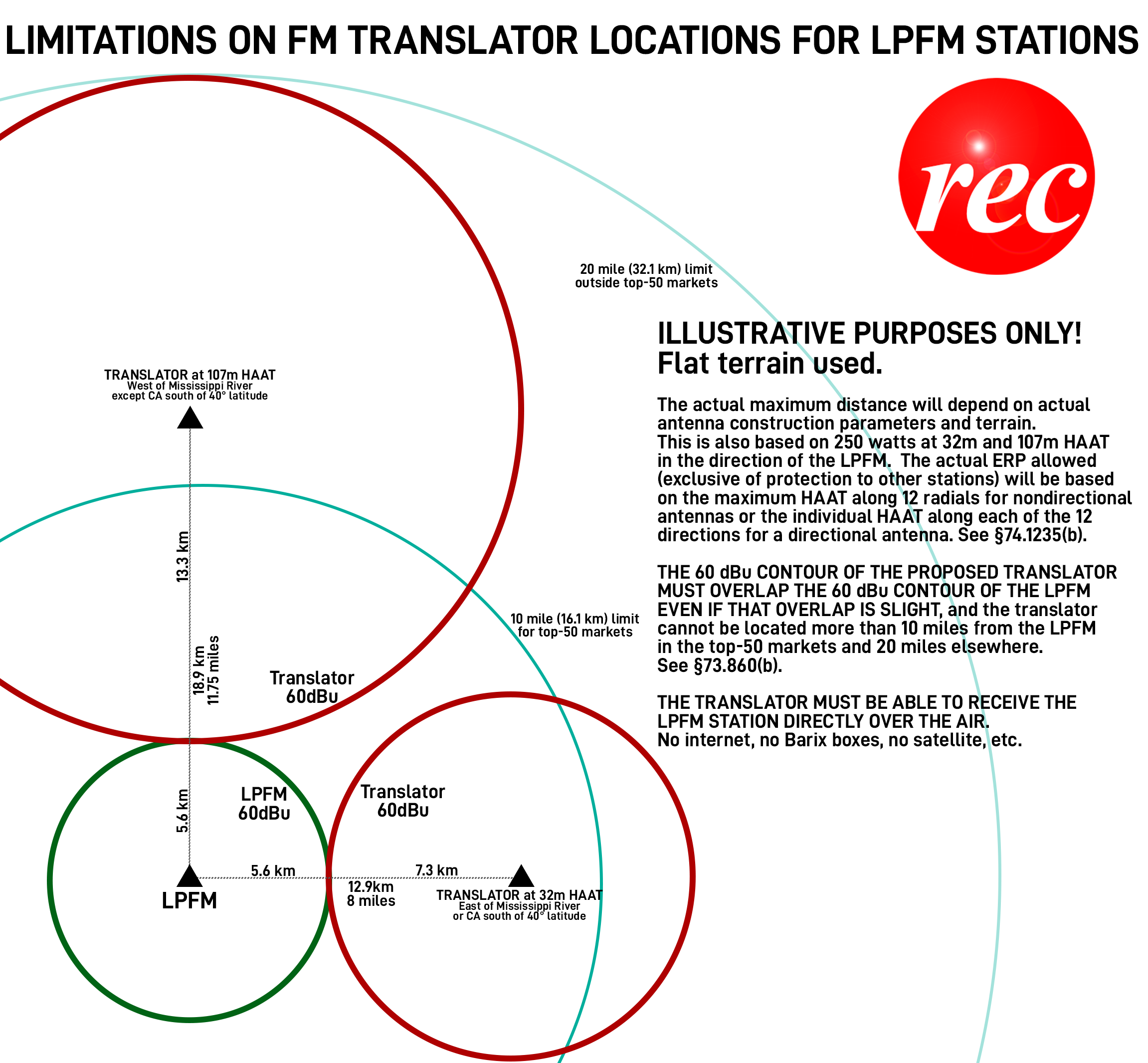
Yes, these rules are restrictive, but they are consistent with the original objectives of the LPFM service which keeps stations focused on a particular “hyperlocal” area. There are some of us who would like to see changes to these rules. In 2022, REC filed a Petition for Rulemaking in what we called Translator Reform. One part of Translator Reform proposed to eliminate the 60 dBu contour overlap requirement and to extend the maximum distance for a translator while maintaining the over the air reception requirement. We had hoped that the FCC would have considered some rule changes to FM translators before jumping the gun with this filing window.
In a past comment period for the ground rules for the upcoming translator window, concerns were expressed by REC, LPFM-AG, Common Frequency and Prometheus regarding the current limitations on LPFM. If the FCC was to consider these issues, it may result in a delay of the filing window. We are not sure who is giving pressure to the Bureau to get this window going (though we do have our suspicions), but there should have been a rulemaking proceeding to reexamine the existing FM translator rules including some rules that have not been examined for over 25 years and to modernize the rules to reflect current market trends.
With that, REC is still accepting shows of interest for new FM translator stations from LPFM and full-service noncommercial broadcast stations. LPFM stations considering translators should keep in mind of these policies and understand if I state that the location where they want a translator is just simply too far away.
If your station wishes to show interest, please email lpfm@recnet.com. Please be prepared with sites identified. We will respond with an information package including the information that we need in order to check for FM translator availability. Please, no phone calls. We need this in writing.
Sixth Report and Order at paragraph 138.
Sixth Report and Order at paragraph 139.
Original Report and Order at paragraph 4.